A new catalogue of works from the Dresden archives: the Saxon Palace in historic drawings
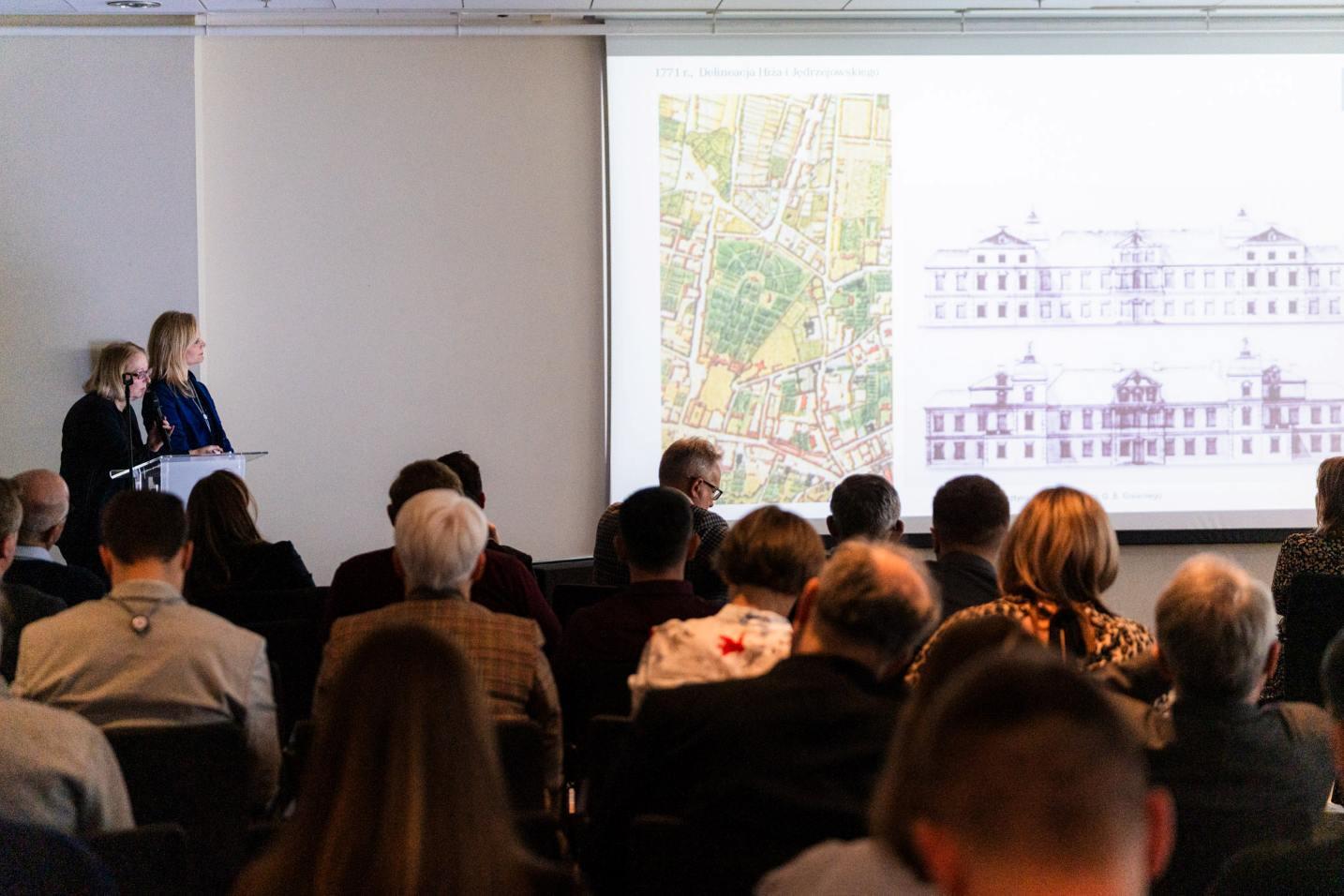
‘Shared Polish‑Saxon Heritage’ is a scholarly catalogue of more than 1,100 architectural drawings from the Saxon era, now held in the Dresden archives. The volume, which includes a collection of essays and is edited by Professors Jakub Sito and Paweł Migasiewicz, was produced in part through cooperation between the Institute of Art of the Polish Academy of Sciences, the Royal Castle in Warsaw, the National Institute of Polish Cultural Heritage Abroad – Polonica, and the Pałac Saski company. The launch of the volume will take place on 2 July 2025 at the Royal Castle in Warsaw.
Publication ‘Shared Polish‑Saxon Heritage’
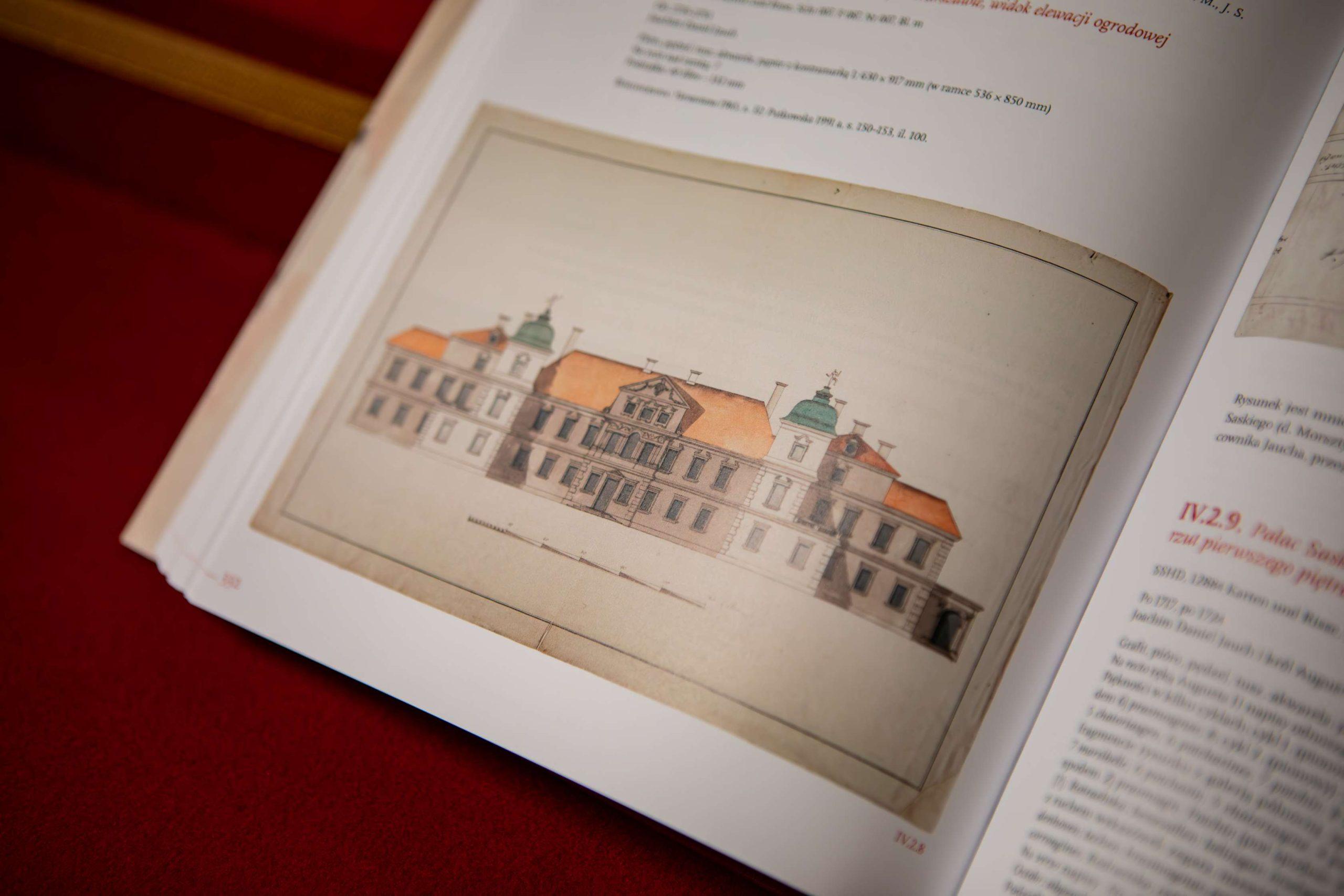
The latest publication, ‘Shared Polish‑Saxon Heritage: Polonica in the Collection of Eighteenth‑Century Architectural Drawings in Dresden’, edited by Professor Jakub Sito and Professor Paweł Migasiewicz of the Institute of Art of the Polish Academy of Sciences, presents architectural drawings relating to Poland from the reigns of Augustus II and Augustus III of the Wettin dynasty, which until now have largely been accessible only to researchers abroad. The project set out to gather and edit the source materials in the Dresden collections (Sächsisches Hauptstaatsarchiv; Landesamt für Denkmalpflege Sachsen). As a result of several years of scholarly work by scholars of architecture and history, a three‑volume publication has been produced. It includes a catalogue raisonné, a collection of drawings arranged chronologically and thematically with corresponding catalogue entries, along with a descriptive and analytical section. This is the most comprehensive publication of its kind to date; previously, only studies covering selected parts of the collection had been available. The volume is further enriched by essays that outline the broader artistic and historical context, focusing on the work of architects and builders in Poland during the Saxon era. The book was published in cooperation with the Institute of Art of the Polish Academy of Sciences, the National Institute of Polish Cultural Heritage Abroad – Polonica, the Royal Castle in Warsaw – Museum, and the Pałac Saski company.

Polish architectural plans in foreign archives
The wealth of Dresden’s collection of architectural drawings, which depict plans for numerous prominent buildings and whole urban complexes in eighteenth‑century Poland, can be traced to more than fifty years of work by the Royal Building Office in Warsaw. Better known by its German name, Bauamt, the office was established at the initiative of King Augustus II before 1715. Among those who headed the office were prominent architects including Johann Christoph Naumann, Joachim Daniel Jauch, and Johann Friedrich Knöbel. During the reign of the first Saxon king to sit on the Polish throne, all documentation produced in Warsaw was sent to the Main Building Office in Dresden. Later, as the Warsaw Bauamt gained autonomy, documentation remained in the city, which saved it from destruction during the Prussian siege of Dresden in 1760. Only after the death of King Augustus III, and the end of the Polish‑Saxon union, were all official materials transferred to the Saxon capital, where they are now stored in the archives.

The Saxon Palace in Dresden archives
Numerous plans and views gathered in ‘Shared Polish‑Saxon Heritage’ form, in essence, a wide‑ranging architectural journey through the furthest corners of the former Polish–Lithuanian Commonwealth. Readers will have the opportunity to ‘visit’ the Old and New Castles in Grodno, the palaces in Dąbrowa, Boguszyce, Kutno, Kleczew, Wawel Castle in Kraków, and Bolimów. The largest share of the collection, however, is devoted to Warsaw, especially the Saxon Layout (Założenie Saskie). This partly realised urban concept includes plans for the expansion of the Saxon Palace (also Saski Palace, formerly the Morsztyn Palace) and for the Saxon Garden, featuring the construction of the Grand Salon, a shooting range, and an opera house (Operalnia). King Augustus II acquired the palace to serve as his own royal residence, separate from the Royal Castle, which remained part of the Polish–Lithuanian Commonwealth. Although the plans were revised repeatedly over the years – with many of the bold, ambitious, and at times even utopian ideas developed during Augustus II’s reign later abandoned by his son and successor, Augustus III – reconstruction of the palace was completed in the 1740s. ‘Shared Polish‑Saxon Heritage’ allows readers to trace, step by step, the dynamic development of what is now the heart of eighteenth‑century Warsaw, and to appreciate the scale of architectural change across Poland. Several of the illustrations from the book can also be viewed in the article ‘The Corpus Christi Procession in the Courtyard of the Saxon Palace during the Reigns of Augustus the Strong and Augustus III’ on our website.
Scholars involved in the research project
The catalogue is the outcome of a research grant from the Ministry of Science and Higher Education, awarded under the National Programme for the Development of the Humanities and carried out between 2018 and 2025 at the Institute of Art of the Polish Academy of Sciences, under the direction of Jakub Sito. The project team comprised: Paweł Migasiewicz, Monika Wyszomirska, Piotr Ługowski, Alina Barczyk, Paulina Kluz, and Agata Felczyńska. Some of the catalogue entries and essays were prepared by Polish and German researchers outside the core team: Andrzej Betlej, Anna Victoria Bognár, Krzysztof Czyżewski, Andrzej Gałkowski, Peter Heinrich Jahn, Piotr Jamski, Hanna Osiecka-Samsonowicz, Stephan Reinert, Michał Wardzyński, and Tomasz Torbus.
Co-financed from the funds of the Ministry of Culture and National Heritage of the Republic of Poland
Reconstruction of the Saski Palace, the Brühl Palace and tenements at Królewska Street – preparation and implementation costs