Contrast
Size
news

Forum of Good Reconstruction Practices. The Saski Palace and the challenges of modernity

What challenges arise when reconstructing historic buildings with the latest technologies? This was just one of the topics discussed during the ‘Forum of Good Reconstruction Practices’, held in March 2025. This expert symposium forms part of the ongoing preparatory works for the reconstruction of the Saski and Brühl Palace complex, alongside the tenement houses on Królewska Street in Warsaw.

From cellar remains to a reconstructed frontage

Participants in the forum, who focused on the reconstruction of the western frontage of Marshal Józef Piłsudski Square, began the day with an on-site visit to the area where the project is currently underway. After a close‑up view of the surviving historic walls of the Saski Palace and the Brühl Palace outbuildings, architects from WXCA Group gave participants a behind‑the‑scenes look, presenting the key principles of their proposal for reconstructing the palace‑and‑tenement house complex, which won the international architectural competition (SARP No. 1040). To appreciate the scale of the project, it is worth noting that the winning concept envisages a total floor area of around 80,000 sq m. The first conference panel concluded with a presentation by Anna Maria Wierzbicka, PhD, DSc, and Alicja Szmelter, PhD, DSc, from the Faculty of Architecture at the Warsaw University of Technology. In tracing the history and describing architectural details, the speakers also highlighted the opportunity to restore the Brühl Palace – a true jewel of Polish architecture.
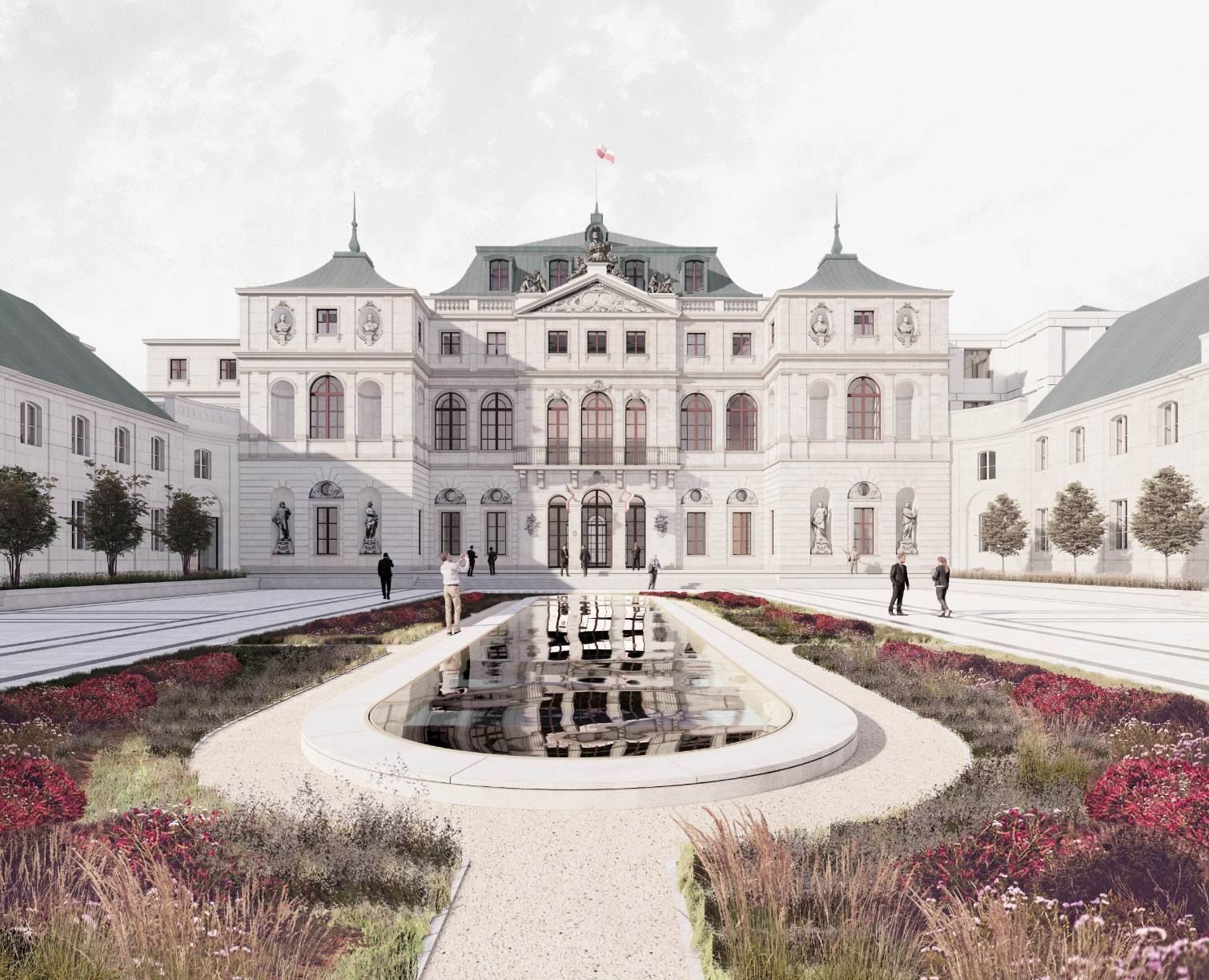
Koncepcja architektoniczna obudowanego Pałacu Brühla. Na pierwszym planie otoczony wąską alejką i niską roślinnością podłużny zbiornik z wodą, w której lustrze odbija się fasada pałacu. Na drugim planie pałac z wywieszoną na szczycie flagą polską. Po bokach mniejsze budynki połączone z pałacem, sześć drzew (po trzy po każdej stronie), a na dziedzińcu spacerują ludzie. Niebo jasne barwy szarej.
Reconstruction of the Brühl Palace, concept by WXCA Group sp. z o.o.

Good Practice Handbook for the reconstruction of the Saski Palace

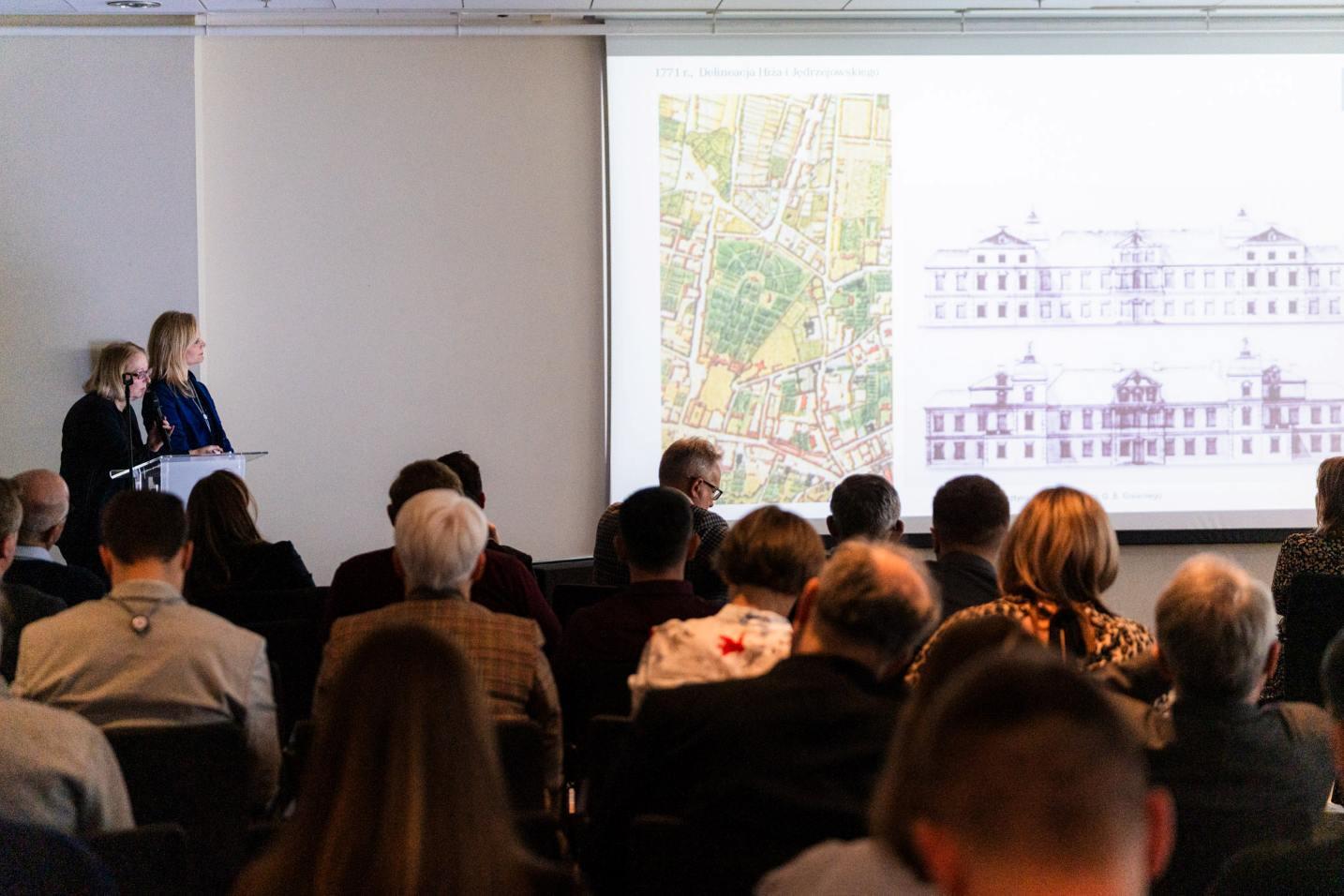
During the second panel of the conference, participants and speakers focused on the challenges of delivering the reconstruction project, setting them against a catalogue of good practice. This part largely summarised a series of expert workshops organised by the Pałac Saski company last year. During the workshop sessions, which covered thematic areas such as stonemasonry, roof structures and window joinery, industry specialists developed, through discussion, the ‘Good Practice Handbook’ – overarching guidelines for delivering the project. Defining these guidelines addresses a key challenge: reconciling the meticulous recreation of the historic architectural form as it existed on 31 August 1939 with modern building regulations and contemporary public realm design.
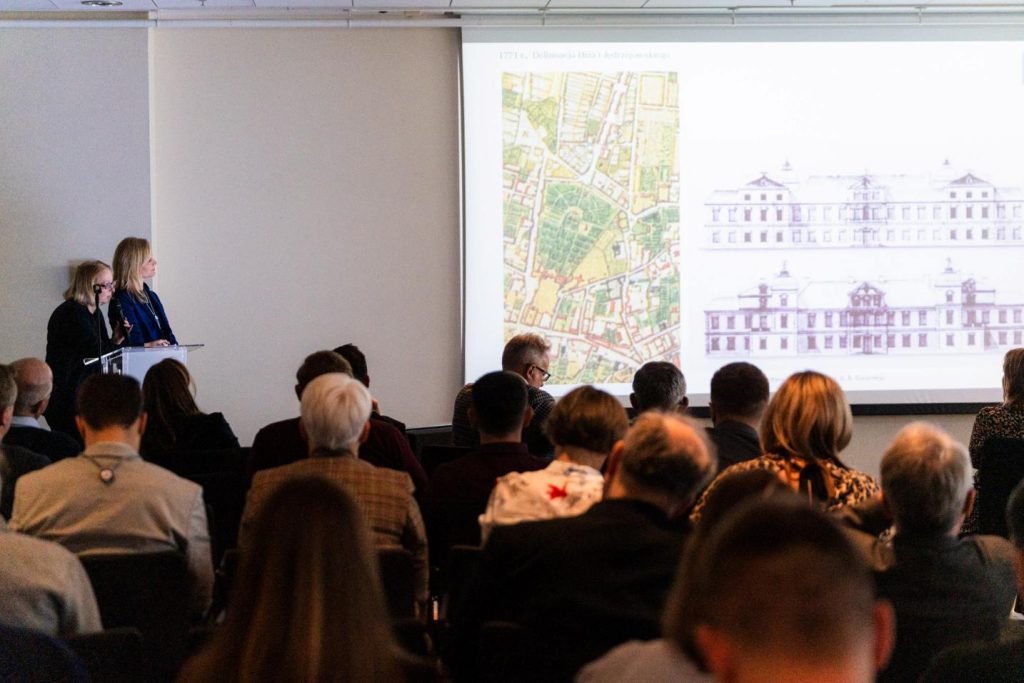
Na pierwszym planie zdjęcia odwróceni tyłem uczestnicy konferencji, za nimi po lewej stronie przy pulpicie z mikrofonem dwie prelegentki. Po prawej stronie ekran rzutnika z wyświetloną mapą fragmentu Warszawy (z Ogrodem Saskim) oraz szkicami Pałacu Brühla, dokumentującymi przemiany jego wyglądu.
Forum of Good Reconstruction Practices. The Saski Palace and the challenges of modernity, 2025. Photo by T. Tołłoczko

One such contemporary strand is ESG (Environmental, Social and Corporate Governance), which was the focus of the conference’s closing presentation. In construction, this entails delivering buildings with minimal environmental impact while meeting social objectives and technical performance requirements. This, in turn, calls for efficient management of the site – or sites, as in the case of the reconstructed Saski and Brühl Palace complex and the tenement houses at 6, 8 and 10/12 Królewska Street.
news

Agreement negotiations for the reconstruction design of the Saski and Brühl Palaces and Królewska Street tenement houses

On 25 August 2025, formal negotiations began between the Pałac Saski company and the architecture practice WXCA Group. That same day, the practice received an invitation to open negotiations on an agreement to prepare the architectural design for the reconstruction of the Saski Palace (also Saski Palace), the Brühl Palace and the tenement houses at […]

29th International Poster Biennale – Exhibition on Piłsudski Square

For the second time, the fencing around the reconstruction site for the Saxon and Brühl Palaces, as well as the tenement houses on Królewska Street, will serve as an outdoor poster gallery. The open‑air exhibition ‘Quo Vadis’, featuring selected works by artists taking part in the 29th International Poster Biennale in Warsaw, will be on […]

A new catalogue of works from the Dresden archives: the Saxon Palace in historic drawings

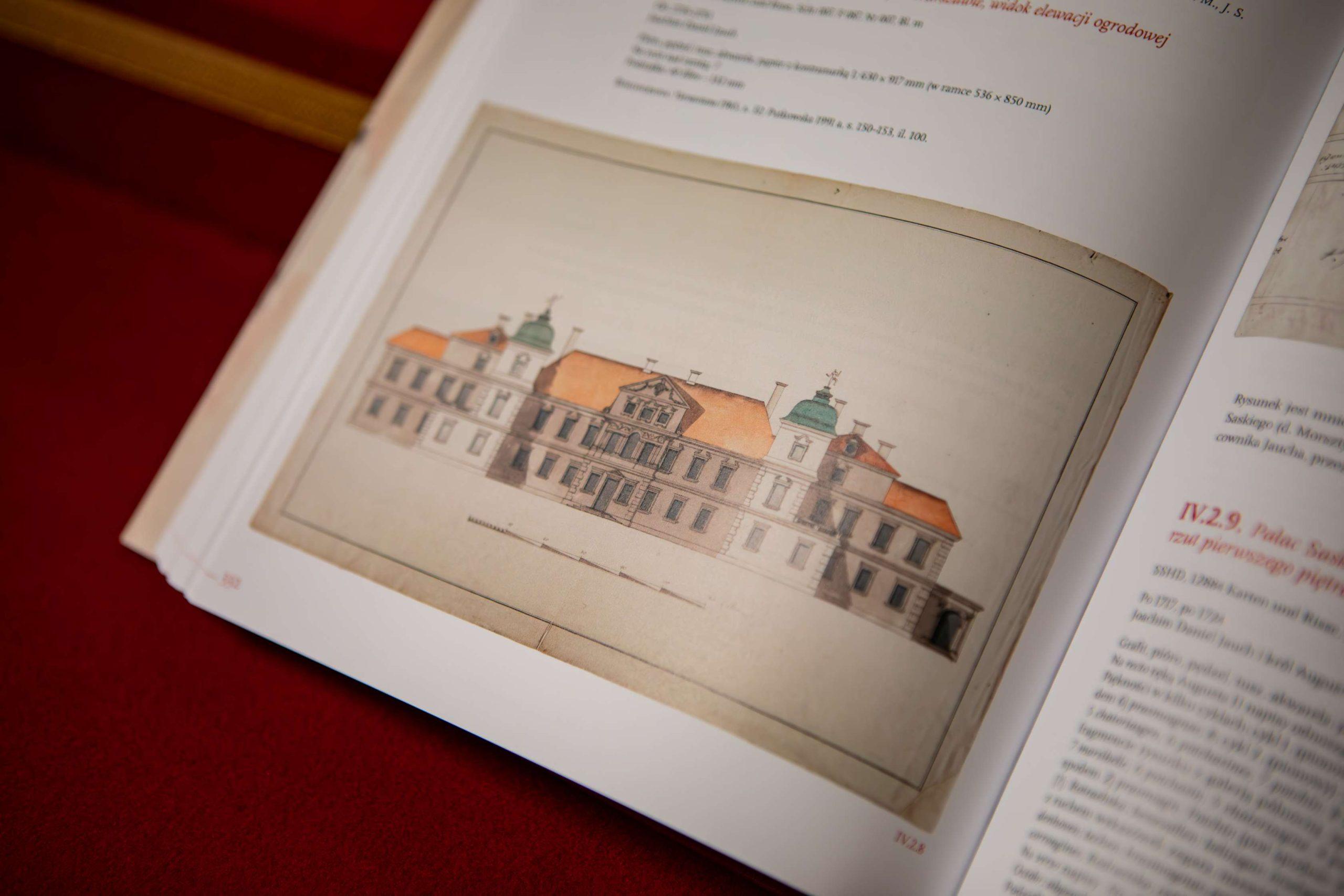
‘Shared Polish‑Saxon Heritage’ is a scholarly catalogue of more than 1,100 architectural drawings from the Saxon era, now held in the Dresden archives. The volume, which includes a collection of essays and is edited by Professors Jakub Sito and Paweł Migasiewicz, was produced in part through cooperation between the Institute of Art of the Polish […]

298th anniversary of the Saxon Garden

The last day of May saw the largest Saxon Garden Festival to date. Nearly 80,000 Warsaw residents and visitors took part in the fourth edition of the all‑day retro event, whose 2025 programme was expanded with contributions from new partners. As a result, alongside musicians, interwar‑period re‑enactors, enthusiasts of penny‑farthings and automobiles, and virtual‑reality specialists, […]

Forum of Good Reconstruction Practices. The Saski Palace and the challenges of modernity

What challenges arise when reconstructing historic buildings with the latest technologies? This was just one of the topics discussed during the ‘Forum of Good Reconstruction Practices’, held in March 2025. This expert symposium forms part of the ongoing preparatory works for the reconstruction of the Saski and Brühl Palace complex, alongside the tenement houses on […]

Historic fragment of the Royal Castle discovered at the Brühl Palace site

On 31 March 2025, at the initiative of the Pałac Saski company, a fragment of a stone plaque that once adorned the Royal Castle’s eastern façade was formally presented to the Royal Castle at a ceremony in the Knights’ Hall. The inscribed sandstone slab, discovered during the first season of archaeological excavations conducted by the […]